

Owner's manual for catamarans
F3Studio for Wider, WiderCat 92
Wider: visionary ideas
Since its foundation, Wider has pursued visionary ideas and developed projects that go beyond the traditional boundaries of the nautical industry.
In 2011, the shipyard’s first model, the Wider 42, featuring a patented cockpit opening system, demonstrated that the propensity for innovation is rooted in Wider’s DNA.
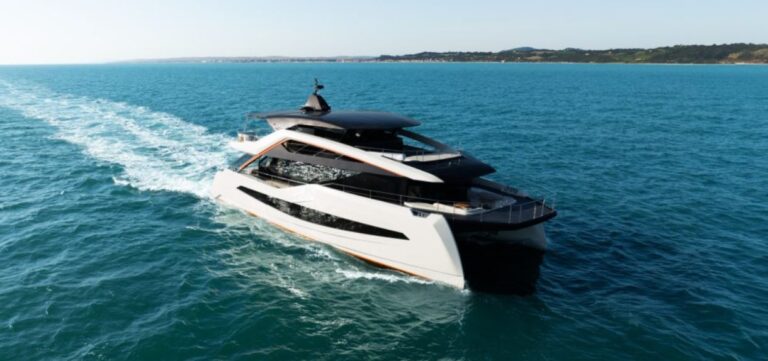
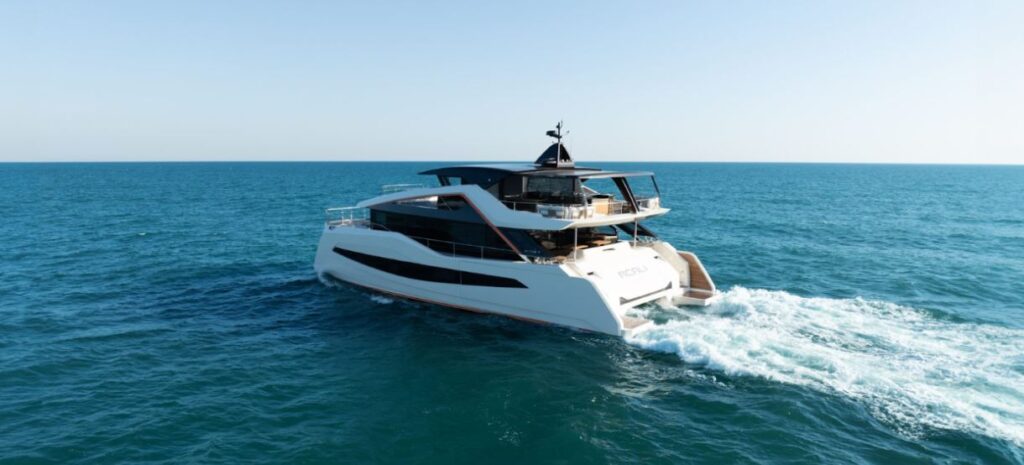
The WiderCat 92, officially unveiled at the 2024 Cannes Yachting Festival, is the first catamaran in the Wider range: a 28-metre hybrid-powered vessel that combines comfort, innovation and sustainability.
For this project, Wider chose F3Studio to draft the owner’s manual, relying on our more than twenty years of experience in technical documentation for yachts and superyachts.
Wider has offices in Fano, Venice and Monaco. WiderCats are built at the shipyard’s facility in the Marche region, located in one of the most renowned areas for Italian shipbuilding, where the expertise of numerous shipyards and a solid network of designers and component suppliers fuel excellence in the sector.
The catamaran owner’s manual: safety on board
Safety on board has always been one of the core pillars of the manuals produced by F3Studio. The same applies to the WiderCat 92, Wider’s hybrid catamaran, where our technical documentation dedicates extensive space to accident-prevention guidelines, emergency procedures and best practices for the safe operation of the vessel.
It has been a pleasure working with you. Great job!
Luciano Cardini
Engineering Manager
Wider Superyacht Division
Fire prevention
Fire prevention occupies a central place within the safety section. This is essential on a vessel like the WiderCat 92, which features multiple electrical systems and lithium iron phosphate propulsion batteries that call for specific attention in terms of control and maintenance.
The risk of fire is always present on board any boat, and in recent years the number of incidents has unfortunately increased, reversing a positive trend that had seen a gradual reduction in cases. In the manual, F3Studio and Wider aim to raise awareness among boat owners about the potential dangers and the importance of informed, prevention-oriented behaviour.
In most cases, fires on board are caused by neglected maintenance, failure to carry out checks or a lack of attention to reducing the possible direct or indirect causes of fires.
The WiderCat 92 is equipped with numerous and diverse safety devices: fire detection systems, fixed fire-fighting systems in the engine room and battery room, seawater systems, 15 portable fire extinguishers (powder and foam), 21 life jackets and two self-inflating rafts, each with a capacity for 8 people.
The manual includes floor plans of the boat, clearly indicating the location of all safety devices, as well as the primary and secondary escape routes. It also includes the electrical diagram of the fire-fighting system, accompanied by actual images of the devices to ensure maximum readability and understanding, rather than simply providing simple graphic representations.
The section is completed by step-by-step emergency procedures for using the self-inflating rafts and making a “Mayday” distress call. Here too, the manual combines explanatory text with photographs of the devices to provide immediate visual support in emergency situations.
Comfort and technology on board
With the WiderCat 92, Wider consolidates its vision focused on efficiency and sustainability, introducing solutions such as electric propulsion and solar panels. At the same time, comfort is another key feature on board. Being a multihull, the available space is much larger than in a monohull configuration of the same length, and Luca Dini Design & Architecture, together with the Wider Style Centre, has been able to make the most of it.
The technological component finds one of its most evident expressions in the bridge, the heart of the boat’s human-machine interface. The owner’s manual devotes ample space to describing the monitoring and control systems developed by Onyx Marine Automation, which interface with the boat’s electrical devices. The document, drawn up by F3Studio, illustrates the main functions, the alarm screens and how to interact with the touch screens.
Comfort and entertainment on board have also been given special attention. The manual includes instructions for the installation and correct positioning of Void speakers and subwoofers, which are fixed to the supports provided in the headliner before use. In the same area, the bar cabinet integrates the necessary connections for housing the DJ plate or mixer. The manual explains how to perform these steps correctly and safely.
Another key system for onboard comfort is the air conditioning, for which the manual illustrates not only how it works, but also the periodic maintenance operations necessary to ensure its efficiency over time.
Finally, the beach club (an area that has taken on an increasingly central role in yacht design in recent years) stands out for its two folding terraces that extend the surface area to 67 m². The manual guides the crew step by step through the procedures for moving the platforms, providing instructions and safety warnings for correct and risk-free use.
Electrical systems and hybrid propulsion
On board the WiderCat 92, there are various electrical systems, each with different characteristics and voltages: 12/24V, 230V, 400V and 700V (the latter being direct current and dedicated to the hybrid system).
The maintenance of these systems plays a crucial role. As mentioned in the owner’s manual, hull vibrations and the marine environment, which is naturally humid and salty, can affect the performance of electrical components. For this reason, the manual specifies periodic checks to ensure proper operation.
The document prepared by F3Studio lists all the electrical panels and sub-panels on board, accompanied by descriptions and references to control procedures.
The hybrid electrical and propulsion management system reduces both fuel consumption and the boat’s environmental impact. The manual clearly illustrates the touch screen display screens and the system’s operating modes:
- MODE CRUISE: provides the necessary power while optimising fuel consumption.
- MODE ZEM (Zero Emission Mode): manages energy sources by avoiding the use of fuel and powering the DC-Bus exclusively via batteries. In this configuration, it is possible to cruise for approximately 27 nautical miles at 6 knots in complete silence, or maintain up to 12 hours of autonomy at anchor without recharging.
- MODE GENSET: emergency mode for returning to port in the event of faults that render the other modes unusable or unsafe.
- MODE HARBOUR: uses direct power from the harbour quay.
- MODE COMFORT: reduces the noise of diesel generators by limiting the available power.
- MODE FULL POWER: maximises available power by increasing the speed of the diesel generator engines.
- DRY-DOCK MODE: used when the boat is dry and connected to a shore power supply.
Electric propulsion is provided by two Danfoss motors, for which the manual provides warnings and maintenance instructions, such as lubricating the bearings, checking for vibrations and checking the electrical connections and earthing.
On sunny days, the 80 m² of solar panels installed on the WiderCat 92 guarantee energy self-sufficiency at anchor: unused energy is stored in batteries and used during the night.
Manual and environmental considerations
The WiderCat 92’s hybrid propulsion system is a concrete choice for reducing environmental impact, an aspect that is also given ample space in the owner’s manual. In addition to reporting pollution prevention regulations, the document refers to certain points in Annex IV of the MARPOL 73/78 Convention.
The environmental issue is closely linked to periodic maintenance: a well-maintained boat is also a more efficient and sustainable boat. The WiderCat 92 is equipped with numerous complex systems and installations, which require regular checks to ensure their correct functioning over time. Seasonal or occasional use of certain components can in fact lead to problems or malfunctions.
In the event of long periods of inactivity, such as during the winter season, the manual recommends storing the boat in a covered storage facility, taking specific precautions for systems that contain water or are exposed to frost.
General guidelines are also provided on cleaning, protection and preservation of the hull and furnishings, with a table summarising the procedures for various materials: painted parts, metal elements, natural teak, wood, outdoor furniture and cushions, windshields and windows.
F3Studio
With over twenty years of experience in technical documentation for the nautical sector, F3Studio has collaborated with numerous shipyards to produce manuals for superyachts, motor yachts, catamarans, day cruisers, RIBs and sailing boats, as well as numerous component manufacturers.
Each manual is tailor-made in accordance with the relevant regulations and technical characteristics of the model, and includes editing, layout and the creation of interactive digital formats.
Relying on F3Studio means being able to count on a partner capable of lightening the load on the technical department and ensuring that you obtain complete, clear and compliant documentation.
F3Studio recently developed YachtServ, an interactive application that allows to manage scheduled maintenance and quickly access documentation and video tutorials.